
30 September | Perspectives

How a low-cost, open-source AI is challenging Big Tech and reshaping the AI landscape
By Santos Nagore and Max Reiff, Partners
DeepSeek R1 recently gained global notoriety for effectively combining established techniques — mixture of experts (MoE), reinforcement learning, and multi-token prediction — into a single AI system that is both powerful and cost-efficient. At first glance, some experts consider this more of a “masterful orchestration of existing methods” than a wholly new discovery. However, the speed and scale at which DeepSeek delivered these optimizations is what truly stands out.
Dario Amodei of Anthropic explains:
Every frontier AI company regularly discovers many of these optimizations: frequently small ones (~1.2x), sometimes medium-sized ones (~2x), and every once in a while very large ones (~10x). […] DeepSeek-V3 is not a unique breakthrough or something that fundamentally changes the economics of LLMs; it’s an expected point on an ongoing cost reduction curve. What’s different this time is that the company that was first to demonstrate the expected cost reductions was Chinese.
This suggests that DeepSeek’s innovation aligns with AI’s broader trend of driving cost reductions through software optimization. As the chart below illustrates, AI inference costs have been rapidly declining due to continuous innovation, with DeepSeek following this trajectory:
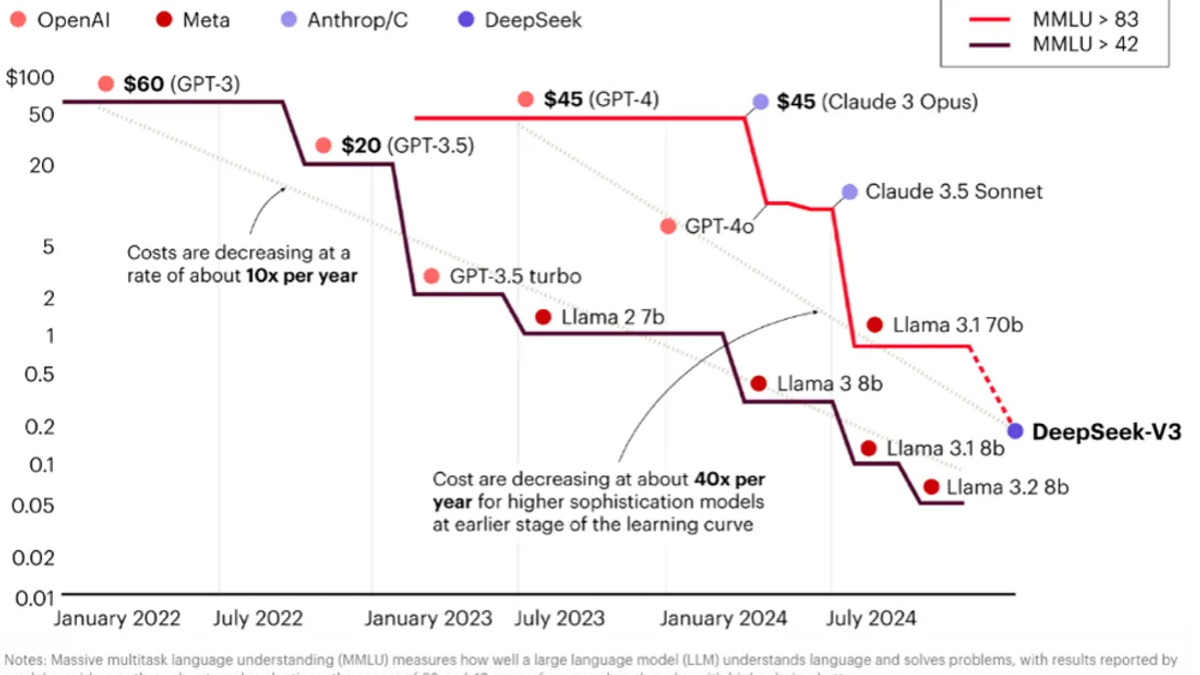
While the trend continues, perhaps most surprising is that an open-source Chinese startup has closed, or at least significantly narrowed, the performance gap with top proprietary models.
Breaking Down the Core Innovation
DeepSeek’s efficiency comes from three core engineering innovations:
Beyond model architecture, DeepSeek also improved how it handles data through three core optimizations:
1. Efficient Computation: DeepSeek uses FP8 mixed precision to speed up processing and reduce energy use by using lower-precision calculations where possible — like rounding numbers to make math faster without losing key details.
2. Better Resource Allocation: Instead of wasting effort on unnecessary data, DeepSeek’s system focuses on the most valuable training examples. It also activates only the model parts needed for a task, similar to turning on lights only in rooms that are in use, making everything run more efficiently.
3. Hardware Optimizations: DeepSeek replaced CUDA with PTX to give engineers more control over GPU performance. It also developed DualPipe, a method that helps GPUs communicate and work together more smoothly, like teammates passing information quickly to finish a job faster.
Together, these optimizations enable smarter computation, more effective learning, efficient resource allocation, and faster hardware performance, making DeepSeek quicker, leaner, and more scalable than traditional models. But again, these results aren’t necessarily surprising, as they align with the broader trend of AI efficiency improvements over time, as shown in the chart above.
Economic Implications
DeepSeek R1 upended AI economics by challenging the notion that cutting-edge performance requires extraordinary budgets. While GPT-4 reportedly cost $80–100 million to train, R1 achieved similar results on just $5–6 million. This should be caveated with the fact that the actual cost of training the model remains unverified, and speculation continues about whether the company utilized a combination of high-end and lower-tier GPUs. Nonetheless, assuming it is relatively accurate, this drastic reduction in cost initially triggered a sell-off in AI chipmakers like Nvidia and infrastructure providers such as Vertiv, as investors feared that major capital expenditures, once considered essential for AI development, were now being challenged. However, analysts later noted that lower AI costs could drive broader AI adoption.
Antoine Chkaiban of New Street Research likened the shift to Moore’s Law, saying “Every time the cost of transistors came down 2x, we ended up buying more than 2x transistors. And the same dynamic will likely play out with GenAI.”Microsoft CEO Satya Nadella echoed this sentiment, referencing Jevons Paradox, the idea that as production costs decrease, demand often increases.

Impact on Hardware Demand
While lower AI costs should drive broader adoption, R1’s alleged reliance solely on export-compliant Nvidia H800 chips (rather than the most advanced GPUs) signals a shift from brute-force scaling to efficiency. Nvidia highlighted R1’s advancements in “Test Time Scaling,” where optimization during inference reduces the need for massive GPU clusters, shifting the balance of compute demand. This efficiency-driven approach has potential to redistribute AI hardware demand, potentially compressing margins over time for high-end chipmakers like Nvidia; a factor contributing to recent stock volatility.
Nonetheless, DeepSeek remains dependent on Nvidia GPUs, albeit less advanced ones like the H800, reinforcing Nvidia’s central role in AI, at least for now. While demand may shift from Nvidia’s most profitable high-end GPUs to lower-margin products, greater efficiency is likely to drive broader adoption, benefiting Nvidia in the near term. However, as efficiency gains permeate across the ecosystem, the AI edges closer to a more hardware-agnostic future, accelerating the transition to a more competitive and less monopolistic GPU market in the long run.
Competitive Market Implications
Beyond hardware, R1’s open-source approach is perhaps even more notable, as it threatens the dominance of proprietary closed-source models like GPT-4, Gemini, and Claude. Researchers and businesses that once relied on expensive API access to closed models can now fine-tune high-performance AI via R1, reducing reliance on major providers. This democratization of AI is set to increase competition, lower AI service costs, and accelerate innovation, expanding revenue opportunities for both hardware and software providers alike. It also suggests that as foundational models become increasingly commoditized, more value will shift to the application layer, similar to the post-dot-com era.
Geopolitical Implications
China vs. U.S. AI Competition
DeepSeek’s rapid rise has drawn attention from major U.S. AI labs and policymakers. Donald Trump warned, “The release of DeepSeek AI from a Chinese company should be a wake-up call for our industries that we need to be laser-focused on competing to win.” This highlights AI’s growing geopolitical stakes, potentially leading to stricter export controls and increased regulatory scrutiny.
Intellectual Property Controversy
A major point of contention is whether DeepSeek leveraged proprietary outputs from OpenAI’s GPT-4 (or GPT-3.5) to train its models. Allegations suggest that DeepSeek used distillation techniques to replicate ChatGPT-like behaviors. According to leaked OpenAI communications:
“We know [China]-based companies — and others — are constantly trying to distill the models of leading U.S. AI companies. We believe it is critically important that we are working closely with the U.S. government to best protect the most capable models.”
This raises ethical and legal questions. OpenAI itself trained on vast internet data, often without explicit permissions, yet now faces concerns about other companies using similar tactics. Whether training a model on another AI’s outputs constitutes fair use or intellectual property infringement remains unresolved.
Conclusion
While seemingly just another point on the innovation curve referenced by Dario Amodei, DeepSeek’s release of R1 marks a pivotal moment in AI, where open-source efforts challenged closed-source dominance and forced adaptation. Though not necessarily a transformative breakthrough, R1’s optimizations drastically reduced costs while maintaining top-tier performance, shifting sector focus from sheer computational might to engineering efficiency and accessibility. As future models achieve frontier-level performance at significantly lower costs, R1’s hardware efficiency has the potential to restructure demand for AI accelerators, favoring a broader market rather than concentrating power among a few hyperscalers.
On the geopolitical front, DeepSeek’s rise has heightened tensions between China and the U.S., while cementing AI’s status as a strategic global asset. As Trump’s remarks highlight, this is no longer just about technology or business; it’s about national competitive advantage. With AI evolving at breakneck speed, how regulators, corporations, and governments respond will determine the future balance of technological power.
Ultimately, DeepSeek hasn’t reinvented AI, but it has accelerated existing trends and heightened competition, proving that the AI revolution is far from slowing down. If anything, it’s gaining momentum, setting the stage for an intensifying technological arms race.