
Saltar al contenido principal
abstract image

The Three Lenses of Venture Investing

INSIGHT / Visión de los Partners / The Three Lenses of Venture Investing

The Three Lenses of Venture Investing

By Max Reiff, Partner


Intuition, Analysis, and Market Awareness

Venture investing is not about a single skill. Some investors read people well. Others read numbers well. The best read both and understand how the world around them is changing.

At IDC Ventures, we see investing as a system with three interlocking components:

  1. Intuition and qualitative judgment to identify great founders early.
  2. Quantitative discipline to scale what works.
  3. Market awareness to ensure both align with the direction of the world.

These dimensions compound, and the best outcomes come when all three reinforce one another.


The Stages of Growth

Each funding stage tests a different dimension of execution.
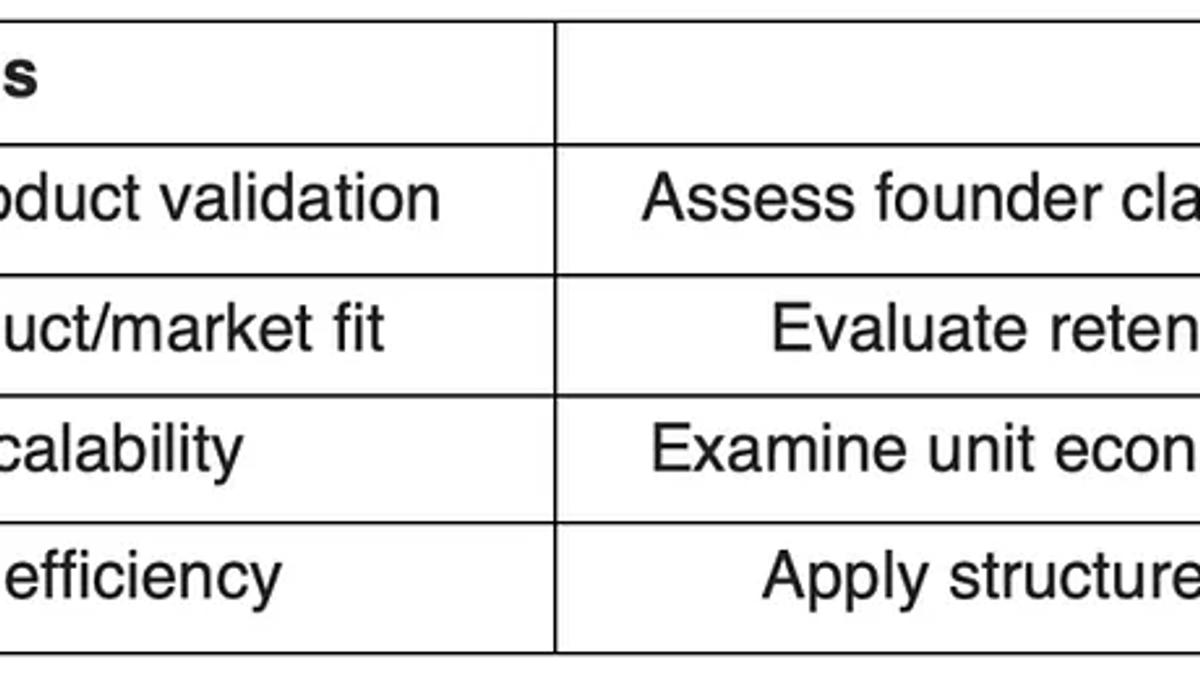
Each round increases visibility and reduces uncertainty, like turning over another card in poker. Early rounds reward judgment and conviction; later ones test systems, scalability, and precision.


The Early-Stage Lens: From Intuition to Insight

In the beginning, the founder is the data. Before there’s revenue to analyze, retention curves to study, or cohort metrics to benchmark, investors must interpret something far more elusive: human potential. These are some of the measurable (or at least observable) indicators we use at the earliest stages.


Qualitative Indicators

  1. Leadership and Magnetism
  • Can articulate a vision that attracts top talent and investors above their weight class.
  • Inspires deep conviction and commitment in others; e.g., would you work for them?

2. Cognitive Range

  • Moves fluidly between vision and detail, abstraction and execution.
  • Demonstrates integrated thinking; alignment between what they dream and how they build.

3. Motivation and Resilience

  • Driven by mission rather than vanity metrics or short-term gains.
  • Realistic about the decade-long grind ahead and able to endure pressure and setbacks.

4. Founder-Market Fit / History of Excellence

  • A record of outlier performance in demanding environments: academic, athletic, or professional.
  • Deep curiosity and direct exposure to the problem; they’ve lived the inefficiency they’re fixing.

5. Speed and Learning Velocity

  • Bias toward action and experimentation over deliberation.
  • Rapid iteration cycles; short feedback loops between idea, execution, and insight.
  • Prefers testing hypotheses in the market over theorizing on whiteboards.

At this stage, investors rely on pattern recognition, as well as empathy: the ability to discern talent and drive before data can confirm it.


The Transition to Evidence

As products meet the market, intuition gains a partner: data. The goal shifts from identifying potential to verifying repeatability.


Quantitative (or Observable) Indicators

  1. Retention and Engagement
  • Early signs of product love: repeat usage, organic adoption, strong DAU/WAU (daily/weekly average user) ratios.
  • Habit formation, whereby users reorganize their behavior around the product.

2. Product Love

  • A product so compelling that users promote it to their peers.
  • Clear advocacy through NPS, testimonials, and community growth.

3. Revenue Quality

  • Growth that is durable, defensible, and improving with scale.
  • Strengthening cohorts that demonstrate expanding value capture over time.
  • Ability to raise prices without churn, proving superior value delivery.

4. Execution Against Milestones

  • Consistent delivery, ideally under-promising and over-delivering.
  • Evidence of operational discipline rather than momentum theater.

5. Capital Efficiency

  • Each dollar invested compounds advantage, not dependency.
  • Burn rate reflects controlled experimentation, not fragility.

By Series A, intuition becomes more of a filter than a compass. The qualitative instincts that guided earlier rounds now coexist with data that serve as a source of truth, separating scalable businesses from promising stories.


The Third Dimension: Market Awareness

You can have a brilliant founder and stellar metrics, but if the market is moving in the wrong direction, none of it matters. Investors need a 360-degree view of markets, technology, and policy to separate genuine disruption from noise.

We ask three questions:

  1. Is this a structural shift or a temporary anomaly?
  2. Will the environment amplify or erode this company’s advantage?
  3. Could the idea itself be disrupted before it matures?

The answers come from constant learning: reading religiously, tinkering directly, talking to operators, engaging across industries, attending key forums, and staying curious about adjacent frontiers.


The Integrated Approach

The magic happens when all three dimensions operate in sync:

  1. Intuition identifies the exceptional founder before others see it.
  2. Quantitative discipline validates the opportunity and guides scaling decisions.
  3. Market awareness ensures you’re riding the right wave at the right time.

No single lens is sufficient. Success compounds when judgment, data, and context converge. The art of investing is integrating all three: knowing when to trust instinct, when to demand proof, and when to step back and see the world shifting beneath it all.

Siga explorando

El capital se crea a través de la conexión y el compromiso.

Contacte con nosotros